Showing posts with label media literacy. Show all posts
Showing posts with label media literacy. Show all posts
Wednesday, November 10, 2010
Random chatting
Omegle is a website for having text or webcam chats with random people. Though it is simply a website for chatting I have to believe it is a game for reasons I will explain. My 7th grade students just told me about this during a class in which they have been working on making posters about internet safety to put up around our school. The website has as its motto "Talk to Strangers" and the statement "Chats are completely anonymous, although there is nothing to stop you from revealing personal details if you would like," both of which are behaviors my students are fully aware should be avoided. But as they showed me the website they were clearly excited and having a great time trying it out to see what happens. The most important reason I want this to be a game is that it is a medium for kids to do something their parents are always telling them not to do. My first thought was that it makes the concept of strangers meaningless to them by reducing them to harmless sources of funny conversations. After a lot of exposure to this stuff will they start thinking of strangers on the street as random people to play around with, flirt with, have a crazy wacky time with? But if they treat it as a game by just playing with it or seeing how long they can maintain a chat before the stranger leaves or seeing how many strangers they can surprise or whatever goal makes it fun for them, then they are participating in an activity with its own set of rules that is apart from reality and strangers will still be strangers, to be wary and suspicious of, in real life. That is my hope, and theories about games should bear it out. Of course, there are many reasons for them to avoid this type of activity online at this website and the hundreds of others like it, such as chatroulette, even if they do treat it as a game. An informal study on techcrunch found that 1 in 8 video chats on chatroulette had content that was not suitable for children. The same study found that a little hacking can determine the IP address of the chat partner, giving at least a general idea of your physical location.


Wednesday, May 05, 2010
Who's Afraid of Copyright Infringement?

Wednesday, July 22, 2009
Creative Commons Licensed Media
I just found this article that lists more than 30 websites where you can find media released for public use (with attribution and varying restrictions). Here is the link: http://www.sitepoint.com/blogs/2009/04/30/30-creative-commons-sources/. Creative Commons Licensing can be a little confusing, so you can learn about it here: http://creativecommons.org/about/licenses.
Tuesday, July 07, 2009
Fair Use Explained Clearly
This document, "Code of Best Practices in Fair Use for Media Literacy Education," is an excellent resource for understanding Fair Use. It puts the power and responsibility of choosing appropriate media for instructional use in the hands of the educator as the law intends instead of making us feel like we are getting away with something by using any media. It also makes clear to me that in cases where I have felt like students' use of media wasn't covered by fair use I was right. "...students may use copyrighted music for a variety of purposes, but cannot rely on fair use when their goal is simply to establish a mood or convey an emotional tone, or when they employ popular songs simply to exploit their appeal and popularity." The original work needs to be repurposed or transformed in such a way that its use contributes to an educational goal.
Thursday, July 02, 2009
Point about Identity in Cyberspace
Reading Lawrence Lessig's "Code Version 2.0." There's a good point about identity on the Internet. "While in real space...anonymity has to be created, in cyberspace anonymity is the given." On the Internet your identity is built from the IP address up. What you add to your IP adds to the picture of your identity. Of course, the main point of the book is that commerce, the law, and government have created an architecture of the Internet that prevents you from accessing many, if not most, spaces without significant creditials that certify who you are.
Thursday, January 22, 2009
Tuesday, April 10, 2007
Vista and the user
I read this article, A Cost Analysis of Windows Vista Content Protection, a week ago and I've been thinking about it a lot. It's long, but well worth the read. The main point is that Vista is a tool for Microsoft to corner the market on home entertainment.
Good Housekeeping gets my seal of approval
You know that magazine on the supermarket racks that you look at and think "Who actually reads that?" Well somehow--I actually don't know how--a copy of Good Housekeeping ended up in my house and I was surprised to read a couple of very good articles. One was about racism in the real estate business continuing to promote segregated neighborhoods. The other was about using Google to find fixes for common problems, like when your iPod crashes or when you need to clean a special fabric. I automatically turn to search engines to answer questions and I really agreed with the author of the article when they suggested taking a little time to find out how others have solved a problem you have by tweaking your keywords rather than throwing something away or spending a lot to have it repaired. Way to go, Good Housekeeping!
Sunday, February 18, 2007
How to Use Wikipedia (Not)
There's a great post up on Andy Carvin's learning.now blog about using Wikipedia for college level research. There are so many misconceptions about Wikipedia out there that this post is wonderful for its clear-headed positions as put forth by Andy and the people he spoke to. Even representatives from Wikipedia itself agreed with the new policy at Middlebury College that says students can't cite the web site in their research. They said Wikipedia is good for getting an overview of a topic and finding references to other reputable websites but it shouldn't ever be considered the definitive authority on a topic. The valuable thing to remember here is that it's both inappropriate to rely on it as the sole authority or ban its use completely. It has great value as an introduction to almost any topic but you've got to take it from there.
Saturday, January 27, 2007
Teaching Critical Consuming
I'm so proud of my 8th graders. We've begun an extended project in which we use an Elgg community, each student with her own blog, to share weekly observations about media. They are assigned to post any thoughts, observations, or discoveries they have during the week related to media, whether it's about advertising or production. Already I've seen two gems: One student student submitted a video clip from a food blog about subliminal advertising on the Food Network (seriously, a huge red "I'm lovin' it!" splashed across one single frame of the Iron Chef) and another noticed that the characters on the OC were all talking very conspicuously on their Verizon phones. I have 28 students. It's like one big Media Awareness Detective Agency gathering mountains of data.
Tuesday, December 26, 2006
Imagining better worlds through virtual worlds

Professor Henry Jenkins, director of the Comparative Media Studies program at MIT, continues to do admirable and innovative work. In this post he manages to articulate the need to stay in touch with the subjects of his thinking and research by creating an avatar in Teen Second Life and humorously addressing the question of whether he should cornrow his beard, which has become the subject of much fascination in this virtual world. He perceptively recognizes that different types of media shape interpersonal relationships and created his avatar in an effort to counter his presence as someone talking down to the Second Life participants on the projected video monitor you see in the picture. In addition to projecting his real self via video conference he also wanted to participate as a virtual person to be on the same level as the other participants. In his words, "Too often, adults talk about kids, maybe even speak to youth, but they don't talk with them. And becoming an avatar seemed like the best way to signal my desire to speak on the same level with my audience. Anyway, it made sense to me."
The event in the picture is a remarkable thing in itself, a conference I think hosted by the Global Kids' Digital Media Initiative, which I think is sponsored by UNICEF, or connected in some way. A lot of speculation here but the whole community looks very interesting and promising to me, like people trying to develop a very positive use of the most cutting edge technology, trying to bring kids from around the world together and, to paraphrase Jenkins (I can't find his quote) "bring what they learn in the virtual community back to their real communities." This post by Eliane Alhadeff on her blog seems to explain it all very well, I just couldn't get through it because some flash player script was driving my aging iBook into the ground.
Monday, November 27, 2006
Media Education and Participatory Culture
I've been reading Henry Jenkins' blog about media and participatory culture. It's constantly illuminating. He's published a paper he did for the MacArthur Foundation entitled "Confronting the Challenges of Participatory Culture: Media Education for the 21st Century," available in installments on his blog and as a pdf from the MacArthur Foundation web site. It offers three very solid reasons that media literacy must be taught thoughtfully and explicitly:
- The participation gap: While most children have access to computers, those who must rely on a library or school for internet access aren't able to consume and produce their own media to anywhere near the degree that those with their own computers and internet access can.
- The transparency problem: Children are more savvy in their consumption of digital media than grown-ups but lack the critical skills necessary to understand how media are being produced and what interests lie behind their production.
- The ethics challenge: Kids' involvement in online media production is usually unmediated by adults and therefore they have little guidance in making ethical decisions about the consequences of what they produce.
I think this paper is huge. It takes a while to digest, but is really worth the time.
Friday, June 16, 2006
Media Literacy Rules 1-3
Rule No. 1: Check a second source.
Rule No. 2: Check another source.
Rule No. 3: Check another source.
Students have to get used to looking at multiple sources when looking up information on the internet. I've come to believe this is the number one best method for finding dependable information. Adults--all internet users--have to learn to do this, and stop giving credence to the notion that just because something is published on the web it's true.
Case in point, I was looking for an ipod recently and happened upon "theipodseller dot com," to which I'm not even linking, it's so dripping with scam. The site boasts 40% discounts on various ipod models because they are going out of the ipod reselling business. The too-good-to-be-true discounts should scream scam so loudly I shouldn't have given the site more than a cursory glance, but because I wanted them to be true I gave the site enough time to do a little background check. Googling "complaints theipodseller" gave me a message board that's collecting info on Apple-related scams. Scrolling down to May 19th you see a list of reports on this site and people have posted their own research about the it, such as the whois info and mentions in articles. The gist is that the domain registrant is connected with several sites that claim to be selling other products for short periods of time and then disappearing. The thing people thought was so weird is that when you actually try to order an ipod you're only able to give them your name and email, no credit card. So my guess is that this is just a mechanism to collect emails to sell to spammers.
The moral of the story is...always get a second opinion, or more.
Rule No. 2: Check another source.
Rule No. 3: Check another source.
Students have to get used to looking at multiple sources when looking up information on the internet. I've come to believe this is the number one best method for finding dependable information. Adults--all internet users--have to learn to do this, and stop giving credence to the notion that just because something is published on the web it's true.
Case in point, I was looking for an ipod recently and happened upon "theipodseller dot com," to which I'm not even linking, it's so dripping with scam. The site boasts 40% discounts on various ipod models because they are going out of the ipod reselling business. The too-good-to-be-true discounts should scream scam so loudly I shouldn't have given the site more than a cursory glance, but because I wanted them to be true I gave the site enough time to do a little background check. Googling "complaints theipodseller" gave me a message board that's collecting info on Apple-related scams. Scrolling down to May 19th you see a list of reports on this site and people have posted their own research about the it, such as the whois info and mentions in articles. The gist is that the domain registrant is connected with several sites that claim to be selling other products for short periods of time and then disappearing. The thing people thought was so weird is that when you actually try to order an ipod you're only able to give them your name and email, no credit card. So my guess is that this is just a mechanism to collect emails to sell to spammers.
The moral of the story is...always get a second opinion, or more.
Wednesday, March 15, 2006
Power Point Stifles Thought and Communication
I've been reading Edward Tufte's “The Cognitive Style of PowerPoint: Pitching Out Corrupts Within”. Arvind's comments on 21 Apples cover most of my thoughts, but after this reading and talking I sat down to try out some of the alternate diagrammatical schemes Power Point offers besides bullets and clipart. It's worse than I could have imagined. All of the non-linear organizational charts are so bound by their extreme adherence to form as to make them completely useless for effective communication. They are airtight containers that constrict all content to their own limitations. Let's take a look at PowerPoint's chart madness, or at least a couple samples for now as I'm getting tired.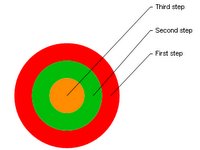
1. The Target is the most rediculous: This is to be "used to show steps toward a goal." The first thing you notice is that the steps are in the wrong order--bottom to top. There's no way to change this since the text and links are immovable. They beg to be dragged around the shape until they're positioned just right, but they won't budge. You can apply some pretty eye-catching styles to your bullseye, though.
2. The Cycle is meant to "show a process with a continuous cycle." That's fine if the cycle you want to illustrate really has no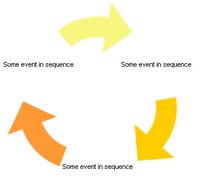 beginning or end. I tried to flip one of the arrows to show how an event might enter the system, but these arrows are stuck like a tram on a cable. The best I could do was copy and paste one and grab at those weird MS Office graphics manipulation handles until one of them flipped it over. Even then, the most the intruding arrow can do is lie on top
 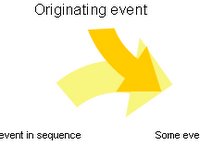 of one that's cemented into place. The handles are flights of fancy you can use to distort the arrows into whimsical but useless shapes, like this nice donut I made.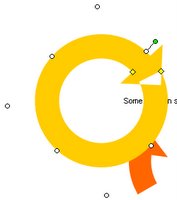

1. The Target is the most rediculous: This is to be "used to show steps toward a goal." The first thing you notice is that the steps are in the wrong order--bottom to top. There's no way to change this since the text and links are immovable. They beg to be dragged around the shape until they're positioned just right, but they won't budge. You can apply some pretty eye-catching styles to your bullseye, though.
2. The Cycle is meant to "show a process with a continuous cycle." That's fine if the cycle you want to illustrate really has no
 beginning or end. I tried to flip one of the arrows to show how an event might enter the system, but these arrows are stuck like a tram on a cable. The best I could do was copy and paste one and grab at those weird MS Office graphics manipulation handles until one of them flipped it over. Even then, the most the intruding arrow can do is lie on top
  of one that's cemented into place. The handles are flights of fancy you can use to distort the arrows into whimsical but useless shapes, like this nice donut I made.
Saturday, December 31, 2005
Impermanence III: Empty Loading Bars

I've been oursourcing information management for a while and depend on external web sites for so much now: protopage for notes and resources, basecamp for project management, del.icio.us for over 300 bookmarks, and most recently I tagged all of my bloglines blogs in kinja. When these servers go down (recently on del.icio.us and kinja at the same time!) I'm left without the information when I need it. When all I can get is an empty loading bar I figure all we can really depend on is our brains, so busy trying to save all this information, pictures and dates and it can disappear in an instant. If del.icio.us loses its database contents we all just have to start over unless we've backed up somehow--even then it won't be easy. My students are more used to this than I am. They get a weak wireless signal and find that their essay hasn't saved to their network drive and they have to start over. And they do. Their only problem is learning temporary backup techniques, like saving to the desktop and resaving to the network when they have a stronger signal.
Monday, December 26, 2005
Impermanence II
I'm thinking of the context in which my students are growing up. I have to get around to preserving the last few years of digital images of my family, printing good photos, burning cds, dvds of captured video. It's so much work! So much easier when it was just on paper to begin with. Sometimes I think, what really needs to be documented, anyway? Then my daughter, 6, asks during a dinner table conversation, "What did you write about in your high school papers?" Lo and behold, I had them in a box in the closet, so I could actually pull out those bad papers and show her. It was worth it.
Impermanence I

This theme is the primary reason I wanted to start a blog. It's the idea that our ability to archive the events of our lives is undergoing a huge transformation and, indeed, the function of personal, family, cultural and human history as well. I'll have to flesh out this theme over several posts as it comes up in various contexts. The first is my feeling upon looking at the Internet Archive. It makes me dizzy. Why even try to preserve it all? Aren't we supposed to wait a while and let the historians decide what was important and the critics decide what's important now? Suddenly, because everyone CAN publish, everything is worth preserving and everyone expects an audience (even me!). I feel like the volume of the whole is diminishing the importance of the individual parts. The ability to publish so easily is a great thing, but I don't think we need to save it all. An eleven-year-old student recently asked me how she could "get on Google" because then she would be famous. I didn't know where to begin, but whatever I said didn't shake her notion that publishing guarantees fame.
Subscribe to:
Posts
(
Atom
)
